
On July 17, 2026, the Department of Justice announced that The Scoular Company, an Omaha-based agricultural supply chain business, agreed to a three-year deferred prosecution agreement (DPA) and will pay more than $10 million to resolve a Foreign Corrupt Practices Act (“FCPA”) case tied to a bribery scheme at the U.S.-Mexico border. The case checks a lot of boxes that compliance professionals should recognize immediately: third-party intermediaries, a commodity-trading business that may not have thought of itself as an FCPA target, a failure to self-report, and a national security angle involving cartel activity, one that was explicitly flagged by the Trump Administration as being a focus.
Grain and oilseed trading is not an industry most people associate with foreign bribery risk. There’s no glamorous government contract, no major state-owned enterprise on the other side of the table, no obvious pressure point where a corrupt official can extract a payment. But that’s precisely why the case is worth a closer look.
The Scoular Bribery Scheme
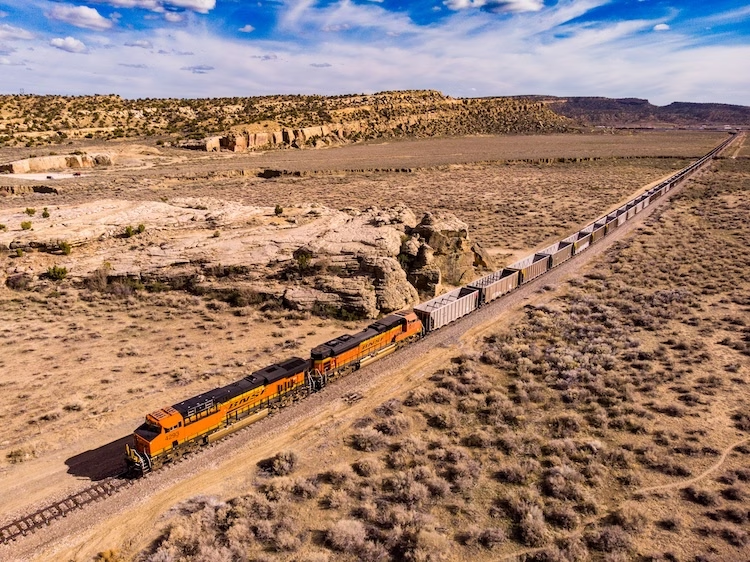
Between 2013 and 2019, Scoular’s shipments crossing into Mexico were subject to routine inspection for dirt, soil, and other impurities. When inspectors flagged a shipment, that meant delay and cost. So Scoular’s third-party customs brokers paid Mexican officials roughly $2,000 per train to make sure they would avoid those delays. The brokers then billed Scoular back for the payments, dressed up as “reinspection fees.” Scoular paid the invoices and their employees authorized and coordinated the whole thing over WhatsApp.
Overall, Scoular ultimately paid $400,000 in bribes that ultimately saved the company more than $6.5 million in fees and delays. In return, Scoular will now pay a $9,769,521 criminal penalty and $414,351 in forfeiture, and will be under a three-year DPA with reporting obligations. A customs broker who handled some of the payments, Carlos Leopoldo Alvelais, already pleaded guilty in October 2025 and on July 20, 2026, and was sentenced to 18 months’ imprisonment and ordered to pay a $250,000 fine for his role in the scheme.
DOJ did not just stop at the company, it went after the individual on the ground, too, which is worth remembering the next time someone assumes corporate resolutions mean personal exposure evaporates.
Nobody at Scoular paid a direct bribe. That’s the point.
If you read the statement of facts looking for a Scoular employee handing cash to a customs official, you won’t find one. The bribes were paid by third-party brokers, at Scoular’s direction and for Scoular’s benefit, then laundered back through an invoice that looked like a legitimate cost of doing business. This is, structurally, close to the oldest trick in the FCPA playbook: use an intermediary so the company’s own hands stay clean. Despite being the most boring example in any generic corporate FCPA training session, this behavior still continues.
What’s easy to ignore is where the intermediary sat. Customs brokers and freight forwarders don’t always show up on the risk radar the way sales agents or “consultants” in a distributor relationship do. They’re viewed as logistics vendors, not counterparties who negotiate directly with government officials holding discretionary power over large contracts or bids. However, these customs brokers essentially sit at a key point where bribery risk will almost always sit: at the physical point where your shipment meets a government employee who can wave it through or hold it up. If your third-party risk program has a tiered questionnaire for distributors and sales agents but treats brokers as a procurement line item, this case is a good reason to fix that.
Additionally, bribes rarely show up on a company’s books labeled as “corrupt payments.” Here they were “reinspection fees,” plausible enough that nobody flagged them for years. Any accounting or finance team reviewing recurring, vaguely-described invoices can fly right past even the most thorough financial controls.
The self-disclosure math
DOJ said plainly that Scoular got no credit under the Corporate Enforcement and Voluntary Self-Disclosure Policy, because it did not come forward on its own. A reminder – the DOJ’s updated Criminal Division Corporate Enforcement and Voluntary Self Disclosure Policy clearly states that, provided certain conditions are met, “[t]he Criminal Division will decline to prosecute[.]” (emphasis added)
That said, Scoular still got credit for cooperating once the investigation was underway — the internal investigation, identifying the people involved, eventually squaring away its document production, helping employees get counsel — plus real remediation: cutting off the broker relationships tied to reinspection fees, rebuilding the compliance function with senior leadership oversight, new third-party screening and contract terms, a rewritten Code of Conduct, and targeted training. That combination led to a 25-percent reduction for Scoular off the bottom of the guidelines range and a DPA instead of a plea.
But notice what’s missing from that list: the biggest lever DOJ has been dangling in front of companies for the better part of a decade. Voluntary self-disclosure is the one variable a company actually controls before an investigation starts, and it’s the one Scoular didn’t have. There’s no way to know exactly what the penalty would have looked like with that credit, but DOJ built this policy specifically to make the math obvious, and this case is a clean illustration of a company paying the difference.
The cartel focus for FCPA enforcement
Most FCPA releases stick to competitive fairness — bribery distorts markets, disadvantages honest competitors, and so on. This one didn’t stop there. The Assistant Attorney General noted that some of the bribe money ended up benefiting people connected to cartel operations at the border, and was careful to say Scoular didn’t know that. The U.S. Attorney for the Western District of Texas went a step further, framing essentially all cross-border trade in that corridor as carrying some baseline risk of indirectly funding cartel activity.
That’s a different register than the usual FCPA press release, and it’s not an accident. It fits a pattern of DOJ leaning more on national security framing across white-collar enforcement generally, not just sanctions and export control cases. For companies operating along the U.S.-Mexico border, or in any corridor with a known organized crime presence, that framing is worth taking seriously on its own terms. This is an area where prosecutorial attention will keep landing, independent of whether the underlying conduct looks like a “classic” FCPA fact pattern.
Takeaways for Compliance Programs
A few practical points worth carrying into your own program:
- Reassess third-party risk beyond the usual suspects. Customs brokers, freight forwarders, and logistics intermediaries at physical points of regulatory friction deserve the same scrutiny as sales agents and distributors. Arguably moreso at times, given how directly they interact with officials who have discretionary power.
- Scrutinize recurring “fee” invoices tied to regulatory processes. Reinspection fees, expediting fees, and similar line items are common vehicles for disguised bribe reimbursement.
- Build a real self-disclosure decision process. Whether or not to self-disclose is a fact-intensive, time-sensitive legal judgment, but companies need an internal process that can get a potential issue in front of decision-makers quickly enough to make voluntary, timely disclosure a live option.
- Don’t overlook informal communications. WhatsApp and similar ephemeral messaging channels are showing up in FCPA statements of facts with increasing regularity; policies and monitoring should reflect where employees are actually communicating, not just where compliance wishes they were.
- Watch the enforcement rhetoric, not just the statute. DOJ’s framing of this case around cartel activity and national security is a signal about where prosecutorial attention and resources is focused, particularly for companies operating along the U.S.-Mexico border or in similarly higher-risk corridors.