
On September 3, 2025, the U.S. Department of the Treasury’s Office of Foreign Assets Control (“OFAC”) announced a settlement agreement with Fracht FWO Inc. (“Fracht”) to settle apparent violations of multiple sanctions programs. Fracht, an international freight forwarder headquartered in Houston, TX, agreed to pay $1,610,775 as a settlement after the company contracted with an airline owned by the Government of Venezuela, utilizing a plane separately designated by OFAC for its operations in Iran, and staffed by citizens of Iran. Fracht ultimately failed to follow their own compliance procedures in this engagement, which ultimately led to senior leadership, including the CEO, approving the transaction.
Fracht FWO Inc. Contracts with a Sanctioned Venezuelan Plane
In May 2022, Fracht’s Mexico affiliate received a request from a major manufacturer for an urgent shipment of car parts from Mexico to Argentina. The Mexico affiliate, lacking the resources and capacity to fulfill the request, sought assistance from Fracht directly. Fracht’s Vice President of Airfreight had recently been introduced to a logistics broker in Mexico and contacted that broker for help. Internally, senior Fracht executives expressed concern that if they failed to fulfill this request quickly, the company would lose a valuable customer.
On May 28, 2022, Fracht entered into a contract with this broker for a flight to pick up and deliver the requested goods. The contract specifically named Empresa de Transporte Aéreocargo del Sur S.A. (“EMTRASUR”) as the carrier, which is a wholly-owned subsidiary of the sanctioned Venezuelan state airline Consorcio Venezolano de Industrias Aeronáuticas y Servicios Aéreos (“CONVIASA”). The contract also specifically noted that the aircraft that would be used was tail number YV-3531. Along with the contract, the broker noted to the Vice President of Airfreight that the aircraft would ultimately arrive in Mexico from Venezuela. Additionally, an unbeknownst to Fracht at the time, the aircraft would be staffed with an Iranian crew. For reasons not outlined in the enforcement action, Fracht entered into this contract without undertaking a sanctions screening or internal legal review, in contravention of its own internal compliance policies and procedures.
The contract and related information ultimately identified several sanctions red flags. CONVIASA had been sanctioned since 2019 under Executive Order 13884 considering the entity is owned by the Government of Venezuela. Furthermore, CONVIASA was subsequently specifically designated itself on February 7, 2020—meaning, that entity itself is named on OFAC’s Specially Designated Nationals List (“SDN List”). The tail number of the aircraft itself, with the affix YV, indicates a Venezuelan vessel. This specific aircraft had also been sanctioned as it was previously owned by the sanctioned Iranian airline Mahan Air.[1] Most decent screening services would have identified the sanctions risks if Fracht had screened any of the listed entities. At the very least, hearing that the aircraft would arrive from Venezuela should have triggered some level of sanctions concern at Fracht.
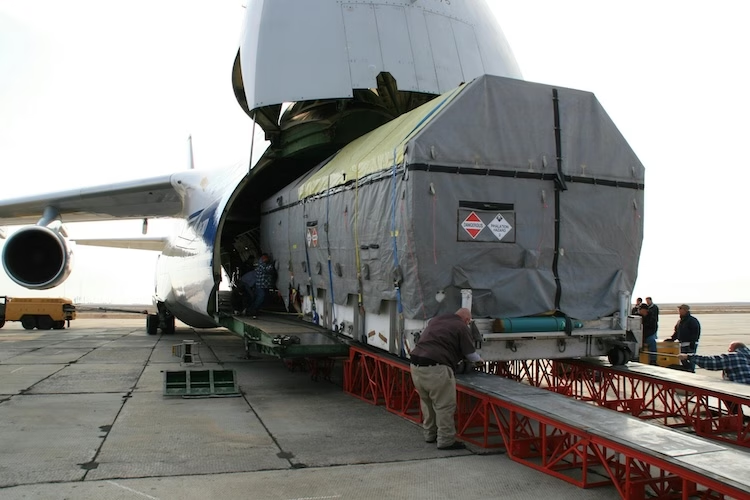
On June 4, 2022, when the aircraft arrived in Mexico and loading began, the ground crew determined that the cargo could not fit as intended, since the plane had been converted from a passenger plane to a cargo plane. The broker presented two potential options to Fracht at that point—it could either authorize the ground crew to unload the plane and reconfigure the cargo, which would delay arrival in Argentina by two days, or the broker could attempt to procure a new aircraft.
At this point, the issue was escalated to additional senior leadership at Fracht. On June 4, 2022, Fracht’s Vice President of Airfreight, Chief Executive Officer (“CEO”), Vice President of Strategic Development, and the CEO of Fracht’s Mexico affiliate discussed the issue in a group chat. When the CEO requested information on the aircraft, the Vice President of Strategic Development noted that Fracht engaged EMTRASUR and that it was a “subcompany of . . . CONVIASA.” No one in the chat identified that these entities were subject to U.S. sanctions. The CEO deferred to the group’s decision to use the current plan and pay an additional fee of $110,000. In total, Fracht ultimately compensated EMTRASUR a total of $995,000.
In reviewing the circumstances surrounding these transactions, OFAC determined that Fracht could face a maximum civil monetary penalty of $2,147,700 under OFAC’s Economic Sanctions Enforcement Guidelines (“Enforcement Guidelines”). While OFAC noted that Fracht cooperated with the investigation, it did not grant the company full credit for a voluntary self-disclosure, as the misconduct was already known to the government by that point.
Additionally, as is the case with all enforcement action, the ultimate penalty was modified based on various aggravating and mitigating factors. These factors, in my mind, are usually the most important content in these enforcement actions as they are great guidance for sanctions compliance professionals.
OFAC’s Findings
OFAC found the following to be aggravating factors:
- Fracht, through the conduct of two of its vice presidents, demonstrated reckless disregard for U.S. sanctions requirements by foregoing the company’s own internal compliance policies and procedures.
- Fracht’s managers, including the two vice presidents and higher-ranking officials, had actual knowledge that this transaction included sanctioned entities.
- Fracht conferred a direct financial benefit of approximately $935,000 to the blocked entity.
- Fracht is a large and sophisticated international organization operating in the field of freight forwarding and logistics globally.
OFAC found the following to be mitigating factors:
- Fracht had no prior violations.
- Upon discovering the apparent violations, Fracht immediately took remedial measures by accelerating its broad and significant sanctions and compliance improvements that were already underway, and remain ongoing. These include:
- Remedial measures with respect to employees involved in the incident, including terminating the employment of the person who contracted with EMTRASUR;
- Mandating that all contracts from customers, airfreight, and ocean freight providers are subject to legal review and sanctions-focused due diligence prior to execution;
- Modifying Fracht’s air freight cargo contract templates to include confirmation of compliance with U.S. sanctions.
- Updating the vendor approval and vetting process procedures to mandate that all vendors be subject to the compliance function’s approval and sanctions-focused due diligence;
- Hiring of additional sanctions compliance personnel (nine full-time compliance employees are now on staff);Committing significant financial resources to compliance (investing more than $1,000,000 annually);
- Enhanced auditing procedures; and
- Implementing quarterly reporting requirements and recurring compliance training for its employees.
- Fracht substantially cooperated with OFAC’s investigation, including by providing documents outlining its business operations and detailed contemporaneous records. Fracht also provided timely and fulsome responses to all OFAC requests.
Lessons Learned from Fracht’s OFAC Enforcement Action
This case highlights the importance of always following established compliance procedures. This sounds obvious, but this is a common blind spot in many organizations. I have seen several prominent, multinational companies maintain some form of expedited onboarding process for third parties that fails to incorporate compliance or legal in any fashion. The Fracht case here highlights that issue, where commercial pressure—the threat of losing a valuable customer— and the urgent nature of the request led to a circumvention of compliance controls. I don’t believe that Fracht intended to or willfully violated sanctions, but the failure to follow its own compliance procedures ultimately led to a “reckless disregard for U.S. sanctions requirements[,]” which ultimately increased its ultimate penalties.
To summarize the key lessons here:
- Embed Sanctions Screening in Urgent Transactions: Fracht’s failure to screen EMTRASUR and the YV-3531 aircraft, despite clear red flags (e.g., Venezuelan origin, CONVIASA affiliation), underscores the need to integrate real-time sanctions checks into time-sensitive workflows. Standard screening tools would likely have flagged these entities, preventing violations.
- Empower Compliance Over Commercial Pressure: Senior leadership, including the CEO, approved a transaction despite known ties to a sanctioned entity, driven by fear of losing a key customer. A compliance or legal professional should be included in high level commercial discussions, such as Fracht’s group chat discussing this transaction. Compliance teams must be empowered with authority and autonomy to override commercial decisions when sanctions risks arise.
- Act Swiftly on Remediation: Fracht’s mitigating factors, such as terminating involved employees, mandating legal reviews for contracts, and investing over $1 million annually in compliance, help reduce its penalty. Immediate and comprehensive remedial actions can demonstrably lower enforcement consequences.
- Integrate Multi-Layered Controls: The violations involved multiple sanctions programs (Venezuela, Iran, WMD, terrorism), highlighting the need for controls that address diverse risks across clients, counterparties, and supply chains. Regular risk assessments, coupled with tailored training and independent audits, are non-negotiable.
- Cooperate Fully with OFAC: Fracht’s timely and fulsome cooperation, including detailed record submissions, was a key mitigating factor. Proactively engaging with OFAC during investigations can mitigate penalties and demonstrate good faith.
[1] When OFAC initially sanctioned it, the aircraft was operating under tail number EP-MND. OFAC subsequently removed the aircraft from the SDN List as of May 2024, nearly two years after the events described herein.